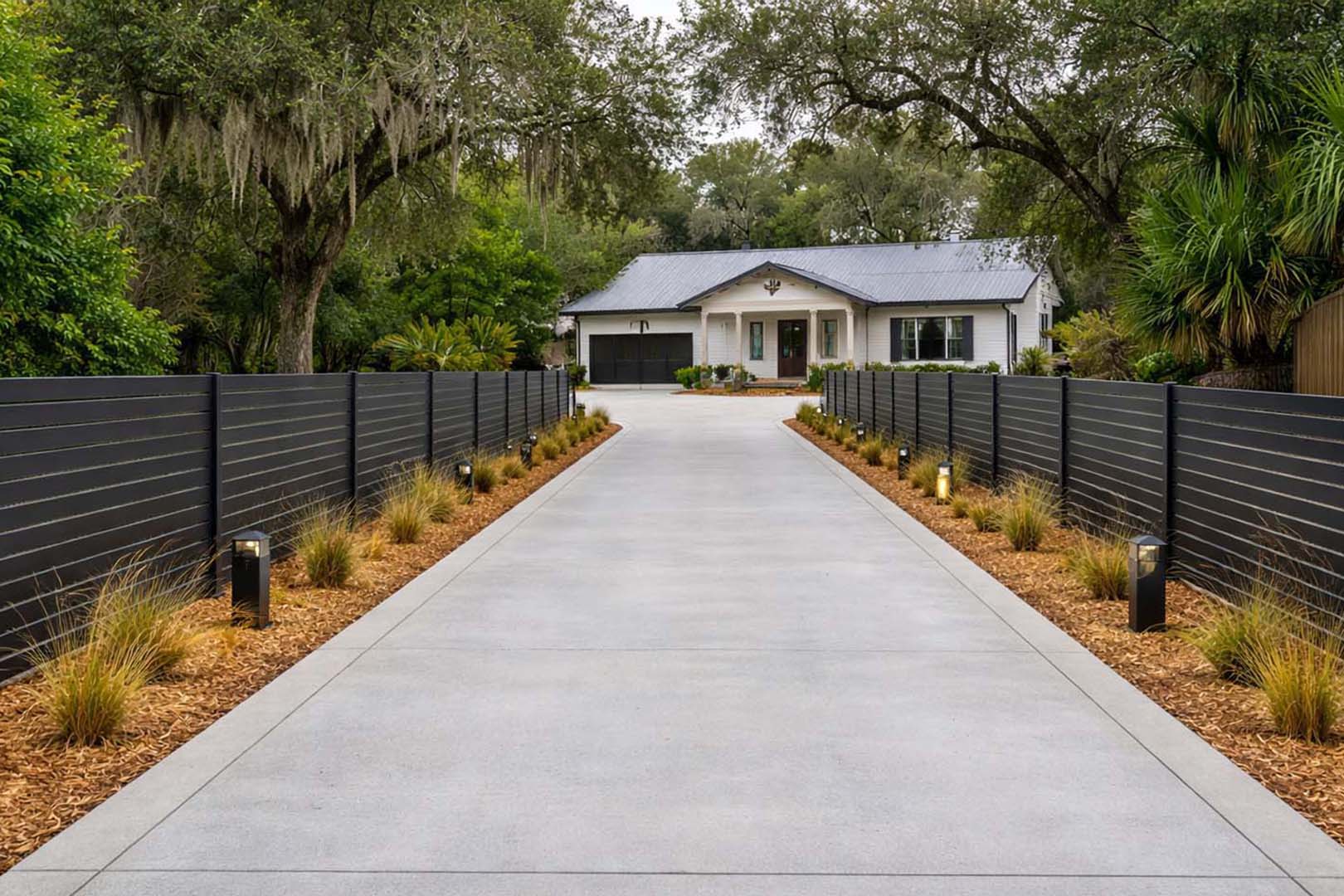

Why our Aluminum Fencing Is Built for Florida Weather


Florida is one of the hardest places in the country to keep a fence looking good. With salt air, constant humidity, a UV index that sits at 9 to 11 for months at a time, sandy soil that gives posts little to hold onto, and an annual hurricane season, a fence here is under attack from the day it goes in.
For this reason, the two most popular premium options in Florida are vinyl and ornamental aluminum. Both are a real improvement over wood, but both come with trade-offs that Florida exposes faster than almost anywhere else. Vinyl goes chalky and brittle under UV and kinks under load. Ornamental aluminum gives you a picket fence with no privacy at all. QuickScreen horizontal aluminum slat fencing sits in the gap between the two: the corrosion resistance of aluminum, adjustable privacy from fully open to fully solid, and stamped structural engineering behind the wind numbers.
Here’s what actually matters for a Florida property.
What Florida Does to a Fence
Salt air
Salt aerosol carries miles inland and relentlessly attacks steel components. In coastal areas, steel hinges and latches can start rusting within weeks.
UV
Florida has one of the highest solar radiation levels in the country. UV breaks down polymer chains in plastics, which is why vinyl chalks, yellows and loses impact resistance over time. While a brand-new vinyl fence could survive a storm, an older one is more likely to crack.
Humidity and rain
Rot, mildew and termite pressure make wood a short-term proposition here. Florida’s subterranean and Formosan termites are among the hungriest in the country.
Wind
Every address in Florida has a design wind speed, which is a number set by the building code that says how strong a wind your fence has to be engineered to resist. It is not a forecast. It is the figure your contractor and your building department work from. Coastal South and Southwest Florida sit around 160 to 180 mph. The Panhandle and central counties run roughly 130 to 160 mph. Miami-Dade and Broward are stricter still, with fixed values near 170 to 175 mph and additional requirements on top.
Aluminum answers three of those four issues outright. The fourth, wind, comes down to how the system is engineered, and that is where an aluminum slat fence is genuinely better than a solid panel.

Wind: What the Engineering Says
QuickScreen’s post system has been assessed by a chartered structural engineer. The report, Quick Screen USA Fence Post Assessment, WILCOXcg, November 2023, calculates wind loads in accordance with ASCE/SEI 7-16 and sizes members to AS 1664.1. It covers wind speeds from 60 mph all the way to 170 mph, which spans much of the Florida range, and it does so across all three of the code’s terrain categories.
Let’s break down what the report confirms.
Post Size and Spacing Buy You More Height
The QuickScreen system is engineered around a 2.56″ square post and a heavy-duty 4″ square post, set at anywhere up to 8 feet apart. Those two choices determine how tall you can build at a given wind speed, and in coastal Florida the difference between them is decisive.
Exposure C is the code’s category for open terrain: flat, open country with few obstructions. This also describes many coastal and waterfront Florida lots. A wooded suburban street is Exposure B and gets easier numbers. Open water frontage is Exposure D and gets harder ones.
Averages across 288 values show that three levers move maximum post height, and each is consistent enough to quote:
| Lever | Effect |
| 2.56″ post → 4″ heavy-duty post | +70% height |
| 8 ft spacing → 4 ft spacing | +40% height |
| Each exposure step B → C → D | -10% height |
Highest design wind speed (mph) that still allows a 6-foot fence:
| Post | Spacing | Exposure B | Exposure C | Exposure D |
| 2.5 in | 4 ft | 130 | 120 | 100 |
| 2.5 in | 5 ft | 110 | 100 | 90 |
| 2.5 in | 6 ft | 100 | 90 | 80 |
| 2.5 in | 8 ft | 90 | 80 | 70 |
| 4 in | 4 ft | 170 | 170 | 170 |
| 4 in | 5 ft | 170 | 170 | 160 |
| 4 in | 6 ft | 170 | 160 | 150 |
| 4 in | 8 ft | 160 | 140 | 130 |
Source: WILCOXcg, Quick Screen USA Fence Post Assessment, November 2023, Charts 2, 5, 8 and 11. Assumes slats installed with no gap.
Three key things to remember:
- The post is the biggest lever. Stepping from the standard 2.5″ post to the heavy-duty 4″ post buys roughly 70% more height, everything else equal.
- Spacing is second. Tightening posts from 8 feet apart to 4 feet apart buys about 40% more height.
- Exposure works against you. Each step from sheltered suburban ground to open terrain to open water costs about 10%.
The key question most people are actually asking is: can I have a 6-foot privacy fence? With the heavy-duty 4″ post, 6 feet is achievable anywhere in Florida. You just close the spacing as the design wind speed climbs, down to 5 feet or tighter at the highest coastal numbers.
With the standard 2.5″ post, 6 feet is an inland proposition. It works up to roughly 130 mph on a sheltered lot with posts 4 feet apart, and runs out well before coastal speeds. At 170 mph on open ground, it tops out near 3.5 feet.
It is important to note that none of that is a limitation of aluminum. It is what any material honestly engineered for 170 mph requires. What it does mean is that you should be skeptical of a quote for a coastal 6-foot fence that puts posts 8 feet apart.
Gaps Between Slats Help
This is the part most homeowners get backwards. A solid fence catches the full wind load. Spacing the slats lets air pass through and reduces it.
The engineering quantifies it: 2.56″ slats with a 1″ clear gap allow post heights to increase by 8.5% over the same fence built with no gaps, and 5.91″ slats with a 1″ gap allow 5.5%. The chart above assumed no gaps at all, so a spaced-slat fence has capacity in hand.
Ends and Corners Need Tighter Spacing
Within a distance of twice the fence height from a free end, post spacing must drop to 45% of what it would be in the middle of the run. Near a corner with a return, it drops to 75%. Corners and terminations are where fences fail first, and this is the rule that prevents it.
The Numbers Cover Strength, Not Stiffness
The report sizes the posts so they will not fail. It does not calculate how far they flex while a storm is passing, because on a free-standing fence a bit of movement does not hurt anything. There is no glass or cladding attached that could crack.
Expect some give in a strong gust. That is normal, and it is the good failure mode: aluminum bends and comes back. Aged vinyl cracks.
QuickScreen vs. Vinyl vs. Ornamental Aluminum
| Feature | QuickScreen Aluminum | Vinyl / PVC | Ornamental Aluminum |
| Steel Components | None; aluminum throughout | Steel post / rail inserts common in wind-rated systems | Steel fasteners on some systems |
| UV Behavior | Powder coat warranted 20 years | Chalks, yellows and becomes brittle over time | Powder coat varies by supplier |
| Privacy | Fully adjustable, solid to open | Solid or picket, fixed at purchase | Open pickets only |
| Wind Engineering | Engineered to 170 mph, exposures B / C / D | Varies; HVHZ requires NOA-approved configuration | Varies by manufacturer |
| Look | Modern horizontal, architectural | Traditional; reads as plastic up close | Traditional / classic |
All three beat wood in Florida, but vinyl’s weakness is what UV does to it over a few years and how it behaves under impact once that has happened. Ornamental aluminum’s weakness is that it was never designed to give you privacy. If you want to screen a pool, a neighbor’s yard or an equipment pad, a picket fence cannot do it.
QuickScreen is the only one of the three where you choose the privacy level.
UV, Color and What the Warranty Actually Covers
Florida sun is the reason so many fences look tired by year five onward. QuickScreen uses an AkzoNobel Interpon D2000 powder coat to the AAMA 2604 standard, carrying a 20-year warranty on the finish, not just the structure. The aluminum itself carries a limited lifetime warranty.
That distinction is worth reading carefully when you compare quotes. Plenty of premium fence warranties cover structural failure while explicitly excluding color fade, which is precisely the failure mode Florida delivers. If a warranty does not cover fade, in this climate it is not covering much.
Maintenance of QuickScreen in a Coastal Climate
QuickScreen requires very low maintenance. On a coastal Florida property:
- Rinse the panels with fresh water periodically to clear salt deposits, especially on the windward side.
- Clear leaves and debris from the base so nothing sits trapped against the posts.
- After a named storm, walk the fence line and check posts and gate alignment.
That is the entire program. No sanding, no repainting, no annual sealing.
Building a fence in Florida? Price your project with the QuickScreen fence calculator, explore aluminum fence panels and double driveway gates, and see the step-by-step install guide.
Frequently Asked Questions
Is aluminum or vinyl better for Florida?
Both resist rot and termites. Aluminum holds an advantage on long-term UV behavior because it does not become brittle with age, and it also offers stronger structural options at higher wind speeds. Vinyl gives you a traditional look at a lower entry price. For a modern horizontal look with adjustable privacy, aluminum slat is the only one of the two that does it.
Will an aluminum fence survive a hurricane in Florida?
QuickScreen’s post system is engineered to wind speeds up to 170 mph, with what you can actually build depending on the configuration. At coastal design speeds, the heavy-duty 4″ post at tight spacing still carries a 6-foot fence comfortably. That engineering is a starting point for a permit set, not a guarantee, and no fence in any material is rated against wind-borne debris.
What post spacing do I need for a 6-foot fence on the Florida coast?
Plan on the heavy-duty 4″ post at 5-foot spacing or tighter. Standard posts cannot reach 6 feet at coastal design wind speeds at any spacing. Inland, where design speeds drop toward 130 mph, the options open up considerably.
Does salt air damage aluminum fencing?
Aluminum cannot rust. It is the steel hardware on most fence systems that fails first in coastal air. QuickScreen uses powder-coated aluminum structural components for that reason.
Do horizontal slats hold up better than solid panels in wind?
Spaced slats let air pass through and reduce the load on posts and footings. The engineering allows post heights to increase by up to 8.5% for 2.56″ slats with a 1″ gap compared with the same fence built with no gaps at all.
Talk to Your Fence Contractor About Foundation Fence Supply
If you want a modern horizontal fence that shrugs off salt air, holds its color through Florida sun, and comes with real engineering behind the wind numbers, QuickScreen is worth a look.
Browse our aluminum fence and gate panels, see completed projects in the gallery, or send us your project details for a quote. We ship nationwide, including Florida.
Request a quote or email sales@foundationfencesupply.com. And when you talk to your fence contractor, builder or landscaper about your next project, ask them about Foundation Fence Supply.